Will the hurt ever end, can the pain ever stop? Perhaps authentic forgiveness can help you move beyond hate and the desire for revenge.
Definitions

- The decision not to seek punishment for those who have harmed you.
- A decision to release yourself from anger, resentment, hate, or the urge for revenge despite the injury you suffered.
- To let go of hope of a different past.
- A change of heart; ceasing to hate.
- Responding to unjust hurt with compassion, benevolence, and empathy.
- Moving beyond bitterness.
- Cancelling a debt.
- Choosing not to act on vindictive passions.
- Discharging—removing the obligation for—a debt owed to you.
- Ending estrangement and letting go of resentment and the urge for revenge.
- Surrendering feelings of animosity and hatred when others harm us
- Peace and understanding that come from blaming less that which has hurt you, taking the life experience less personally, and changing your grievance story
Related Terms
Amnesty—a general pardon for past offenses—is a variant of forgiveness that may focus more on the needs of the offender than of the aggrieved.
The Vindictive Passions
Vindictive passion—intense feelings of resentment, anger, hatred, and the desire for revenge against those who wrong us—are an integral part of human nature. They originate from the need for self-defense, for preserving our self-respect, and for maintaining moral order—our clear understanding of acceptable and unacceptable ways to treat humans. These passions are real, natural, genuine, legitimate, useful, and valid emotions. The goal of vengeance is to quench these vindictive passions.
While a moderate and proportional response to your injury can be appropriate, submitting totally to these passions is often very dangerous, especially when they are used as an excuse to justify destructive, sadistic, cruel, excessive, or violent behavior.
We control our actions. We are responsible for the choices we make. We can choose not to submit to these passions. We can exercise self control, allow the passions to dissipate, and choose to forgive. Vindictive passions may have every right to being the first word, but they don't have to be the last word.
The Paradox of Forgiveness
I know they are wrong. If I forgive them, how will they ever learn and change? I will never forgive them. I can't possibly let them get away with it. If I forgive them they will have won. I can never condone what they did; it is unforgivable. Despite these common objections, the truth is that forgiveness is an act of courage and not an act of weakness. Forgiveness is correlated with better physical health, reduced anxiety, reduced anger, and increased self-esteem. Forgiving may elicit a sincere apology which can provide additional comfort. As we reach out to the ones who hurt us, we are the ones who heal. Forgiveness restores the congruence between what you desire and what is possible and constructive.
To condone an offense is to overlook or disregard a harmful action without protesting or expressing disapproval. Abuse can never be condoned, it needs to be prevented and stopped. But forgiveness is not about overlooking, endorsing, or excusing an offense. It is not about accepting the unacceptable. Forgiveness is about releasing yourself from destructive emotions and a hurtful past. It is not about the offender, it is about yourself. You can forgive the abuser without condoning the abuse. The past does matter and it may make sense never to forget an outrage. Remembering may not be easy, but forgetting may be impossible.
Forgiveness is not:
- Letting wrongdoers off the hook,
- Failing to hold people accountable for their actions,
- Forgetting, denying, ignoring, or overlooking the wrongs that have occurred,
- Repressing genuine feelings of hurt, anger, or hate.
- Condoning, excusing, or justifying bad behavior, unkindness, or abuse or becoming complicit in continuing it,
- Denying, minimizing, or excusing your hurt or your feelings,
- Condemning the offender, demonstrating they deserve to know they are wrong, or that you are morally superior.
- Contingent on seeking justice or compensation. It is not a bi-lateral transaction; it is a unilateral act of generosity.
- Placation or simply calming down. While equanimity is valuable, forgiveness requires more than a superficial tranquility.
- Insincere, thoughtless, casual, often easy, or a sign of weakness.
- Equivalent to trust. Forgiveness can be given, but trust must be earned.
- Contingent on religious beliefs.
Repentance
Repentance is:
- a remorseful acceptance of responsibility for your wrongful and harmful actions, along with
- a repudiation (disowning, renunciation) of your character traits that led to the wrongdoing, along with
- the resolve to eliminate the renounced character traits, and
- the resolve to make reparations—compensation to the victim—for the harm you have caused the victim and to make them whole again.
Repentant people feel guilty and may seek out their own punishment. They become recommitted to community values. Sincere repentance cannot be coerced, it has to be given voluntarily.
It is often reasonable to make forgiveness contingent on some change or transformation in the wrongdoer. Sincere repentance of the wrongdoer makes forgiveness easier, but it is not an essential prerequisite to forgiveness. The choice is yours.
Power Reversal and Transformation
Victims often have a goal to regain their power; to reverse roles, feel less like a victim, and to exercise power over the wrongdoer. This is often the goal of revenge. Being a victim is an insult, the wrongdoer sends the message that he is powerful and you are not. Transforming yourself from the powerless victim to the one with power may require you to see a transformation in the wrongdoer. This transformation may be expressed as their repentance, or apology. In any case, since it is your choice if and when to forgive, you have the power.
Forgiveness and Punishment

Forgiveness is entirely consistent with the continued demand for punishing the wrongdoer. The purpose of forgiveness is to release the victim (yourself) from the vindictive passions. The purpose of punishment is to prevent future harm by preventing the recurrence of injuries. Visiting the wrongdoer in jail to express your forgiveness, while insisting he serve out his full sentence, is consistent with both of these goals. Forgiveness does not forbid punishment, what it forbids is punishment out of hatred. Christ himself, known as a champion of forgiveness, is said to have driven the money changers from the temple.
Who can forgive
Only the actual victim of a wrong has the standing to forgive the wrongdoer. Person “A” cannot forgive someone who wronged person “B”. You can forgive yourself, end your shame and respect yourself.
One step at at time
Authentic forgiveness is a process that requires particular understanding and analysis to be effective. It may require a long period of time for you to be prepared to sincerely forgive. Authentic forgiveness is often difficult to accomplish.
The process must begin with an acknowledgement and careful analysis of your hurt, anger, or hatred. What happened; what are the facts of the event? What do you perceive as the injustice? How do you apportion responsibly for the injustice? What was your role? What role did others play? Why did they act as they did? Can you understand their point of view?
The next step is for you to make a decision and to choose to forgive. A key step is your decision to put aside any claim to revenge, regardless of how justified or subtle it may be. Until you are able to totally let go of your thoughts, feelings, or intentions for revenge, you are not yet ready to forgive. You may need more time, more information, more dialogue, or you may need to consider the offender's perspective from a more compassionate point of view. To be ready to forgive you must decide to bear (dissipate, dissolve, endure, overlook, tolerate, absorb, let go of) your own pain rather than pass it on.
The next step is to tell them you forgive them. This is done fully and unconditionally, without any requirement for an apology, acknowledgement, remorse, repentance, or reparations.
If you still hate, then you have not yet forgiven. When you are beginning to wish the person well, you have accomplished genuine forgiveness. Are you able to feel goodwill and express kindness toward the person?
Reconciliation is a Step Further
Forgiveness is a change within yourself. Reconciliation requires a change within someone else. Forgiving is a unilateral step toward reconciliation, but reconciliation must be bilateral and reciprocal. Reconciliation requires that both sides agree on the facts, the hurt, the motivation, and that each can understand the other's point of view. It requires each to understand a consistent or compatible account of what happened, why it happened, and the consequences of what happened. Reconciliation requires fact finding, discovering the truth, dialogue, empathy, fully telling your story, agreeing on the truth, acknowledging the pain, acknowledging responsibility, establishing trust, equalizing or reversal of power and stature, remorse, apology, and forgiving for a meaningful transformation to take place. Reconciliation may also require reparations—payments intended to compensate a victim for a loss. The goals of reconciliation are to prevent repetition of the harmful behavior and ensure healing and healthy co-existence. Genuine reconciliation leads to helping each other.
Motives
Although many people reject the idea of forgiveness and relentlessly pursue revenge, people also have a variety of motives, reasons, and expectations for forgiving. These are arranged here from the least constructive to the most sincere, authentic, and autonomous.
| Motive |
Expectation, Rationale, Belief, or Defense |
| Revenge |
After I get my revenge, the score is settled and I may be able to forgive you. I certainly won't forgive you until I get a full apology from you. |
| Fear |
You will hurt me (exercise your dominance over me) again if I don't forgive you (or at least profess my forgiveness) for abusing me the last time. |
| Obligation |
I have been taught to “forgive and forget”. My boss, parents, pastor, god, or friends expect me to “bury the hatchet and get over it.” I am obliged to “turn the other cheek” whether I want to or not. This is superficial and insincere reciprocity. |
| Appearances |
I can look good by taking the high road and pretending to overlook your offense. I'll keep the grudge to myself. This is good for my image. We can establish a quid pro quo. |
| Justice |
You will pay your debt to society through the justice system. I have my closure and can move on. I accept the rule of law to resolve this issue. Just punishment leads to a just world. |
| Harmony |
Let's all get along. If I don't talk about the issue it will go away. Just forgive and forget and we can move on and be fine. Let's all play nice together and nothing bad will happen. We have to get along with each other. We have to find a way to continue to work together. I'll give in and forgive to preserve our relationship. |
| Pity |
“Forgive them father for they know not what they do.” We tend to pity and forgive the weak, the young, and the frail rather than hold them responsible for their transgressions. |
| Release |
I am tired of begin angry, hateful, and vengeful. I don't want you controlling my life any more. I am choosing to release myself from the need to control, change, or punish you. I am letting go of my bitterness. I have had a change of heart and no longer hate. |
| Empathy |
I may not understand why you caused such harm, but perhaps it made sense from your point of view. I wish the best for you, even if I don't condone what you did. This motivates authentic forgiveness. |
The Paths of Forgiveness
Understanding when to forgive, the effect it can have on ourselves and the offender, and its relationships to apology helps us to manage our relationships and feelings. The following figure illustrates choices we have and paths we can take to either prolong or resolve our hurt. Use this like you would any other map: 1) decide where you are now, 2) decide where you want to go, 3) choose the best path to get there, and 4) go down the chosen path. If you can arrange a constructive meeting with your adversary, use this map to discuss where each of you are now and to choose a path leading to resolution of your conflict.
You may wish to print out this one-page version of the Paths of Apology and Forgiveness map.
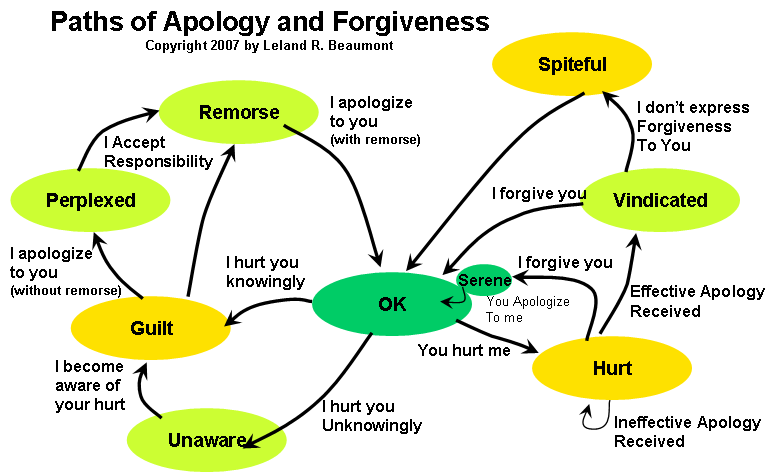
This diagram is an example of a type of chart known by systems analysts as a state transition diagram. Each colored elliptical bubble represents a state of being that represents the way you are now. The labels on the arrows represent actions or events and the arrows show paths into or out of each state. You are at one place on this chart for one particular relationship or incident at any particular time. Other people are likely to be in other places on the chart. This is similar to an ordinary road map where you plot where you are now, while other people are at other places on the same map. Begin the analysis at the green “OK” bubble, or wherever else you believe you are now.
The following is written in first person; “I” and “me” refer to the aggrieved, and “you” refers to the offender.
OK: This is the beginning or neutral state. It corresponds to being free of hurt, anger, hate, or guilt; including a full reconciliation of hurt or guilt The green color represents safety, tranquility, equanimity, and growth potential.
You hurt me: You did something (or neglected to take action) that hurt me physically, materially, or psychologically. It could be a slight, insult, betrayal, injury, assault, theft, or anything else that harms me or humiliates me. This is an example of the “insult” path on the “Paths of Anger” chart.
Hurt: I feel humiliated, angry, resentful, bothered, or just plain bad. I am annoyed at you, my offender. This is an instance of the “Angry” or “Resentful” states on the the “Paths of Anger” chart and it can lead to all the destructive states described there. The yellow color indicates my pain and resentment, and the need for caution in choosing the next path.
I forgive you (before an apology): Even though you have not offered me an apology, I decide to let go of my hurt. I forgive you and gain a serene inner peace and satisfaction for myself.
Serene: My unilateral forgiveness puts the hurt in the past, allows me to get on with my life, and provides me with a serene and tranquil inner peace. I am OK now, but you may still need to apologize at some time for a full resolution. I may feel proud of myself. This is shown touching the OK bubble, because I am feeling OK. The green color acknowledges my peace.
You apologize to me (in response to my unilateral forgiveness): In response to your expression of forgiveness, you apologize to me. The relationship is now OK and fully reconciled.
Effective Apology Received: The offender offers me an effective apology. I feel vindicated because you have acknowledged your responsibility in causing me harm.
Ineffective Apology Received: An insincere attempt to patch things up, a failure to acknowledge your responsibility, lack of remorse, attempts to explain away your actions, a failure to acknowledge your understanding of the injury you caused, or any of several other omissions causes the apology to fail. I remain hurt by the original offense, and now I hurt even more because you tried to make yourself feel better, without addressing my needs.
Vindicated: You admitted your error, your responsibility, and my hurt. Perhaps you made reparations and showed genuine remorse. In any case, I feel vindicated because you have taken responsibility for my pain. The greenish color acknowledges the hurt may be over, while the yellowish color recognizes this may be hurtful to you and my forgiveness is still required for a complete resolution.
I forgive you (after an apology): You have apologized, the hurt is over, and I feel compelled to forgive you. The relationship is reconciled and we are both OK again.
I don't express forgiveness to you (after an apology): Even though you have made a sincere and effective apology, I decide not to forgive you, or at least not to express forgiveness to you. I let you suffer, perhaps only for a few minutes, or hours, or maybe for days, weeks, and years. I am enjoying my new power over you, and remaining spiteful.
Spiteful: You have humbled yourself and apologized to me, yet I decide to withhold forgiveness. Don't go too far with this, hubris goes before the fall. The yellow color indicates the need for caution in choosing the next path.
I hurt you unknowingly: You have taken offense, you are hurt, and I am clueless and unaware of your hurt, or what I have done to offend you.
Unaware: I am clueless and unaware of your hurt, or what I have done to offend you. The greenish color acknowledges you may feel OK, while the yellowish color recognizes that awareness will lead to guilt.
I become aware of your hurt: After reflection, reappraisal, or dialogue with others, I recognize I have hurt you. I now feel guilty.
Guilty: I now understand that I have transgressed your sense of justice and morality and hurt you. The yellow color represents the dangers I can face and cautions about the choices I can make.
I accept responsibility: When I accept responsibility for what I did to hurt you, I become remorseful.
Remorse: I feel genuinely bad about the hurt I have caused and I take responsibility for the hurtful choices I made. The greenish color acknowledges remorse can be only one step away from a resolution while the yellowish color recognizes that a full restitution is still required.
I apologize to you (with remorse): I can authentically express to you my responsibly and remorse and make a successful apology.
I Apologize to you (without remorse): I realize you feel hurt, but I have no idea why. I apologize anyway to try to patch things up. I become perplexed because I don't feel responsible for your hurt, yet you are clearly distressed.
Perplexed: I am confused because I don't feel responsible for your hurt, yet you are clearly distressed. If I later understand my role and take responsibility, I will feel remorse and can fully resolve the dilemma and reconcile the relationship. The greenish color acknowledges you may no longer feel guilty, while the yellowish color recognizes that you feel conflicted.
Quotations
The paradox of forgiveness has inspired many thoughtful quotations. Here are some of the more thought provoking ones:
- “Resentment is like taking poison and hoping the other person dies.” ~ St. Augustine
- “To err is human; to forgive, divine.” ~ Alexander Pope

- “There is no revenge so complete as forgiveness.” ~ Josh Billings (1818 - 1885)
- “Remember that a life well lived is your best revenge.” ~ Fred Luskin.
- “Always forgive your enemies; nothing annoys them so much.” ~ Oscar Wilde (1854 - 1900)
- “The weak can never forgive. Forgiveness is the attribute of the strong.” ~ Mahatma Gandhi (1869 - 1948)
- “The stupid neither forgive nor forget; the naïve forgive and forget; the wise forgive but do not forget.” ~ Thomas Szasz
- “Forgiveness does not change the past, but it does enlarge the future.” ~ Paul Boese
- “You cannot change the facts of the past but you can change the meaning of the past.” ~
- “Forgiveness is not an emotion, it's a decision.” ~ Randall Worley
- “Forgiveness is the answer to the child's dream of a miracle by which what is broken is made whole again, what is soiled is again made clean.” ~ Dag Hammarskjöld
- “It really doesn't matter if the person who hurt you deserves to be forgiven. Forgiveness is a gift you give yourself. You have things to do and you want to move on.” ~ RealLivePreacher.com,
- “The hatred you're carrying is a live coal in your heart - far more damaging to yourself than to them.” ~ Lawana Blackwell
- “The quality of mercy is not strain'd, It droppeth as the gentle rain from heaven Upon the place beneath. It is twice blest: It blesseth him that gives and him that takes.” ~ William Shakespeare (1564 - 1616), “The Merchant of Venice”, Act 4 scene 1
- “It is not the wrongdoer's repentance that creates forgiveness, but the victim's forgiveness that creates repentance.” ~
References
On Apology , by Aaron Lazare , by Aaron Lazare
Bone to Pick: Of Forgiveness, Reconciliation, Reparation, and Revenge , by Ellis Cose , by Ellis Cose
Forgiveness Is a Choice: A Step-By-Step Process for Resolving Anger and Restoring Hope , by Robert D. Enright , by Robert D. Enright
When to Forgive , by Mona Gustafson Affinito , by Mona Gustafson Affinito
Forgive for Good, by Frederic Luskin by Frederic Luskin
Getting Even: Forgiveness and Its Limits , by Jeffrie G. Murphy , by Jeffrie G. Murphy
Revenge: A Story of Hope, by Laura Blumenfeld
The Art of Happiness: A Handbook for Living , by the Dalai Lama, Howard C. Cutler , by the Dalai Lama, Howard C. Cutler
The Wisdom of Forgiveness: Intimate Journeys and Conversations , by Dalai Lama, Chan Victor , by Dalai Lama, Chan Victor
A Human Being Died That Night: A South African Woman Confronts the Legacy of Apartheid , by Pumla Gobodo-Madikizela , by Pumla Gobodo-Madikizela
Field Notes on the Compassionate Life: A Search for the Soul of Kindness, by Marc Ian Barasch
The International Forgiveness Institute is dedicated to helping people gain knowledge about forgiveness and to use that knowledge for personal, group, and societal renewal.
The Forgiveness Web, an Internet resource for forgiveness
Forgiving.org, A campaign for forgiveness research.
Learningtoforgive.com, Learn to forgive for good to reduce anger and hurt. See especially the Nine Steps to Forgiveness.
What is Forgiveness, Adapted, with permission, from Dr. Fred Luskin’s Book: Forgive for Good
Of Repentance, an essay by Michel de Montaigne.
The South African Truth and Reconciliation Commission, was set up to help deal with what happened under apartheid
The Greensboro Truth and Reconciliation Commission was an independent body seeking truth and healing transformation for Greensboro, N.C., a city left divided and weakened by the events of Nov. 3, 1979.
The Parents Circle, Bereaved families supporting peace, reconciliation, and tolerance.
SNAP, The Survivor Network of those Abused by Priests.
The New Zealand Family Group Conferences is a justice system designed to prevent recurrence of youth crime.
The New Zealand Treaty of Waitangi, keeping promises made in 1840 and resorting a damaged community.
|

