|
Limbic Attractors
Reusing Patterns
It all seems familiar to you. You can recognize this in an instant. Here we go again. Stop pushing my hot buttons.
Definitions
- High usage paths and organizing structures in our memories.
Hebbian Learning
Donald Hebb developed a theory of human memory and learning that helps explain how memory is represented, how patterns are learned and reused, how patterns rely on and extend prototypes (i.e. symbols), and how activating one memory can prime associations with other memories. The theory also explains how we build strong associations of particular emotions with particular events and places, and particular behaviors with specific emotions. developed a theory of human memory and learning that helps explain how memory is represented, how patterns are learned and reused, how patterns rely on and extend prototypes (i.e. symbols), and how activating one memory can prime associations with other memories. The theory also explains how we build strong associations of particular emotions with particular events and places, and particular behaviors with specific emotions.
| Consider how as a young child we learned to recognize the letter “H”. We begin with the pristine memory of a child, represented here as a plain blue background of unlinked neurons. |
|
|
|
We were first shown a simple, block letter “H”, told the name of the letter, asked to say the name, and perhaps asked to copy the letter. This was repeated many times. According to the Hebbian learning theory, what is happening is that a particular set of neurons (show here in green) were all activated together each time the letter “H” was seen, spoken, and written. A particular memory trace is being formed (out of the blue) by linking together these particular neurons, associating them with the letter “H” and strengthen the association with each exposure to the letter “H”. The brain makes memories by enhancing the couplings between concurrently firing neurons. These connections typically consist of tens of thousands, or perhaps millions of neurons. A mental symbol for the letter “H” is being created and it is associated with the particular sensory experience of an “H”. |
| Through similar drill and practice we also learned to recognize the letter “A” and a particular set of neurons, dedicated to recognizing the letter “A” were activated. We also learned to distinguish between the letter “H” and the letter “A”. Recognition soon takes place in an instant. |
|
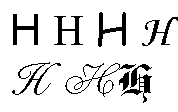 |
But as we see here, the letter “H” is not always represented by a block letter. In fact, we learn to recognize a wide variety of representations of the letter “H” including letters of nearly any size, many common font-faces used in typography and commercial printing, various script forms, including hand-written and machine created representations, and a variety of decorative forms of the letter. But in each case, two parallel, nearly vertical bars are bridged by a horizontal bar. So as we learn the variety of forms of the letter “H”, we continue to strengthen the original prototype representation of the block “H”. The Hebbian learning model is sometimes simplified to the phrase: “cells that fire together, wire together”. In practical terms, such a mechanism means that when a Hebbian layer is presented with an input pattern it has already seen, it will trigger a strong response. When it is presented by a pattern that is new, it will output a weak response. |
Recognizing Patterns
Our brain relies on limbic attractors to quickly classify perceived phenomena into known and familiar patterns. These are the mental symbols that are shorthand representations of objects and concepts. Consider how our brain might distinguish the letter “H” from the letter “A”, while taking into account all of the forms of “H” and “A” that are usually encountered. Upon seeing a particular character, certain neurons are activated. If these activated neurons form a pattern most like the “H” attractor, then the letter is recognized as an “H”. Similarly, if it is most like a “A”, then it is recognized as an “A”.
| But what about an new or ambiguous character like the one show here, how is that recognized? There are several possibilities. Both the “A” and the “H” attractors will tug on this new character in an attempt to recognize it. |
 |
Imagine this novel character starting to move along the path of recognition, as yet uncommitted and undecided between the “H” and the “A” path. During evaluation and recognition it might be more strongly attracted to the “H” prototype, or it might be more strongly attracted to the “A” prototype and it will be classified and recognized accordingly. Alternatively, it might be so new that it is rejected by both existing attractors and it will be recognized as a new and distinct character as it begins to create its own traces in memory as it begins to form an new symbol.
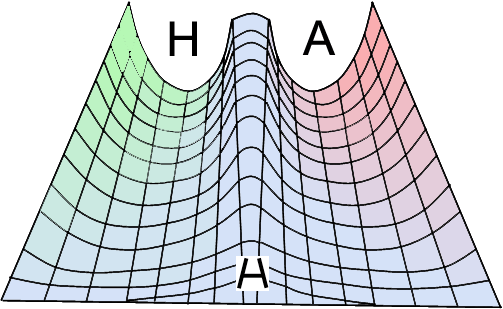
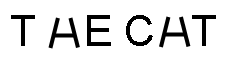
| Perhaps the context can provide some clues to the correct classification of this ambiguous character. For example, if the character appears in the example text, it is very likely that the phrase will be read as “THE CAT” and not as “TAE CHT”, although on a character-at-a time basis, either possibility is equally likely. |
 |
Associations
When the ambiguous character is placed in the words “The” and “Cat” our prior associations of T-H-E and C-A-T immediately made us recognize the first instance as a “H” and the second instance as a “A”. Memories are inherently associative. Seeing or thinking of one object, person, or emotion, inevitably activates memories of related topics, objects, or feelings. For example, if we think of a particular cat we might have had as a family pet, a number of specific associations are activated in our minds. These might include “fur”, “purring” “soft”, “paws”, and “black”. Associations can even bring to mind objects that do not exist, as in this Kanizsa triangle:
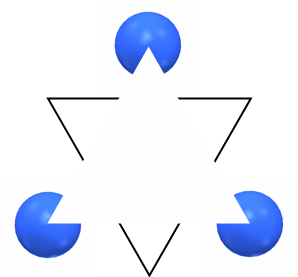
You cannot help seeing a white triangle that you know does not exist in this diagram of six line segments and three sphere sections.
These associations are learned; they are at the learned responses level of the architecture for interaction. Through conscientious effort they can be unlearned, reprogrammed, or extinguished.
In the Groove — Stuck in a rut
Emotions evoke strong associations; reflecting past associations and combining them with the present. They selectively activate past memories associated with the same feeling. One emotional association will often dominate, suppressing more subtle but opposing feelings. It is like trying to ignore the triangle you know is absent from above figure. Depressed people see only despair, enraged people see only hate, hopeful people may fail to consider realistic options.
Roles from the past may overtake a person who is placed in an old familiar context. Adults may revert to acting like children when they are around their parents. Memories of an unpleasant childhood can overtake adults years afterwards. Old love interests can evoke strong feelings long after you thought it was all over. These are the hot-buttons, the taboos, and the topics that can't be addressed rationally that plague many of us.
But we can remain autonomous; our conscious understanding of what is happening allows us to make constructive choices. Attractors pull us in one direction, but they can be recognized, resisted, and overcome. It may be easiest to go where the attractors are pulling us but we can resist their tug, continue toward our goals, and remain responsible for our actions.
References
A General Theory of Love, by Thomas Lewis, Fari Amini, Richard Lannon
|
Fear, Sadness, Anger, Joy, Surprise, Disgust, Contempt, Anger, Envy, Jealousy, Fright, Anxiety, Guilt, Shame, Relief, Hope, Sadness, Depression, Happiness, Pride, Love, Gratitude, Compassion, Aesthetic Experience, Joy, Distress, Happy-for, Sorry-for, Resentment, Gloating, Pride, Shame, Admiration, Reproach, Love, Hate, Hope, Fear, Satisfaction, Relief, Fears-confirmed, Disappointment, Gratification, Gratitude, Anger, Remorse, power, dominance, stature, relationships
|

